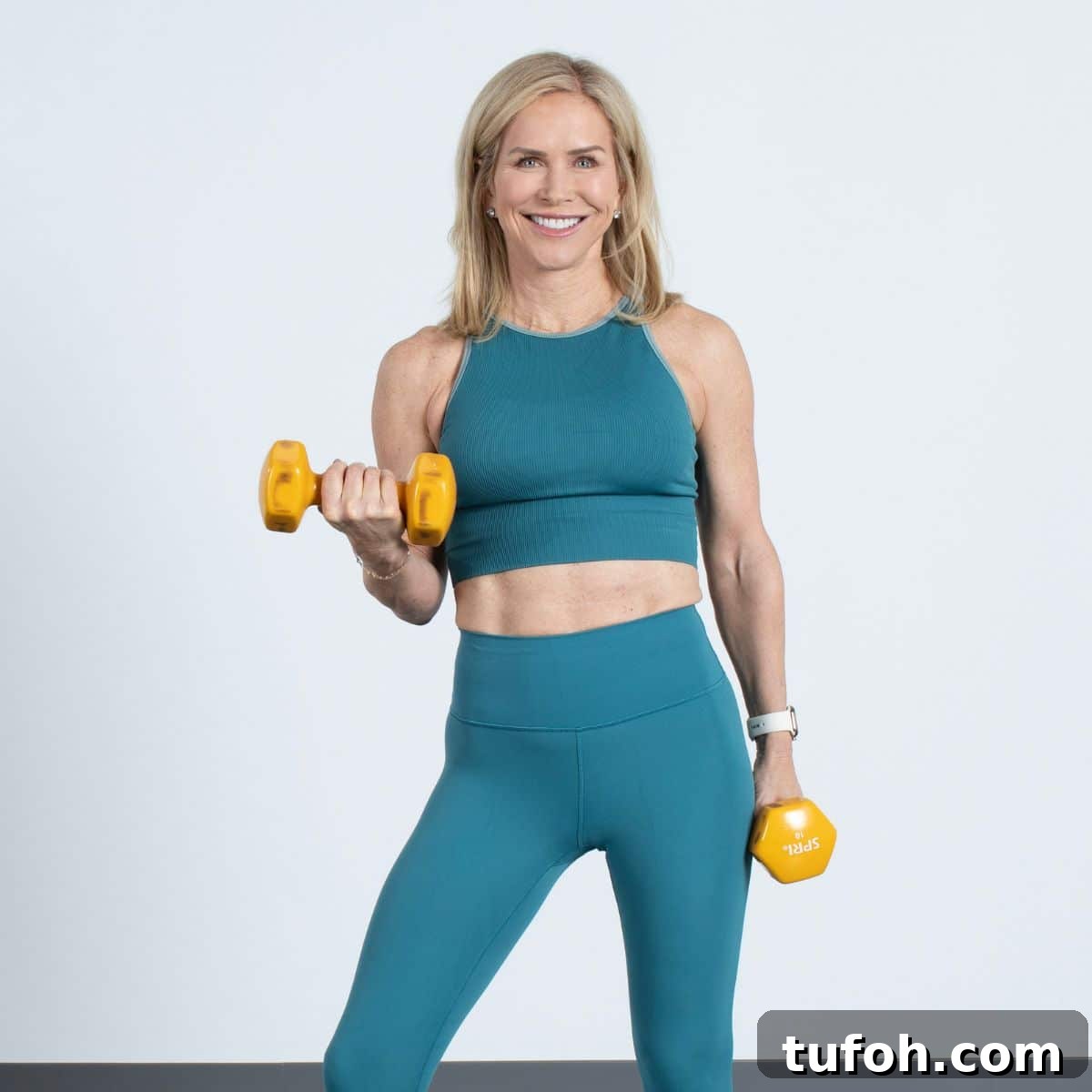
A question I get from women every week is: when should I increase the weight I use? This is an important question because knowing when to up your dumbbells matters for steady progress, motivation, avoiding plateaus, and getting results.
I often write about the benefits of strength training for midlife women and why muscle strength supports longevity and healthy aging. If you already do resistance training, you’ve probably wondered the same thing.
Many women worry that lifting heavier will make them bulky. For most women, the opposite is true: using heavier weights with fewer reps typically helps to:
- Increase lean muscle mass and improve body composition
- Boost metabolic rate
- Sculpt muscle and increase daily energy
It’s never too late to build muscle. Many women become stronger as they age because they dedicate time to their health. Research and practical experience show that regular strength training can reverse or reduce signs of aging in muscle, bone, balance, and energy.
If you think you may be ready to increase your weights, check the items below. After teaching strength classes and lifting for 30 years, here’s practical advice on when to increase your dumbbells.
Consistent Ease
If your current dumbbells feel easy for most or all of your workout, that’s a clear sign to increase the resistance. Muscles adapt over time, so exercises that once challenged you may no longer do so. Weight training should require effort—those last reps should feel challenging.
Repetitions Increase
If you’re consistently reaching the high end of your rep range with ease (for example, doing 12–15 reps when your target is 8–12), it’s time to increase the weight. Hitting your target rep range comfortably means your muscles aren’t being pushed hard enough to change.
No Muscle Fatigue
Some muscle fatigue or that satisfying “burn” during and after sets is a sign you’re challenging your muscles. If you don’t feel any fatigue at the end of a set, raise the weight so your muscles must work harder to stimulate strength and growth. A good rule: aim to struggle with the last few reps and keep sets under about 15 reps.
Plateaus in Progress
If your strength or muscle gains stall despite consistent workouts and good form, your weights may be too light. Increasing resistance forces muscles to adapt and can help you break through plateaus.
Improved Technique
As your form improves, exercises will feel easier. That’s progress—but it also means you should challenge yourself with heavier weights to continue building strength and definition. Always prioritize good form before adding load.
If you’re new to weight training, consult beginner guides and focus on mastering technique before increasing weight.
Minimal Soreness
You don’t need to be sore after every session, but consistently feeling little or no soreness can indicate your muscles have adapted. Gradually increasing the weight can reintroduce a degree of soreness and signal continued adaptation and growth.
Energy Surplus
If you finish workouts with plenty of energy left, your weights might be too light. Increasing resistance will demand more effort and leave you appropriately fatigued afterward.
Time Elapsed
Progressive overload means gradually increasing demand on your muscles. A practical guideline is to reassess and adjust weights every 4–6 weeks. That window allows for adaptation and gives you time to measure progress safely.
The Bottom Line
If your goal is to build strength and shape muscle, you’ll need to lift heavier at times to break down muscle fibers so they can repair and grow back stronger. Light weights with high reps still have value for endurance, but heavier weights are key for getting stronger and more toned.
For older women, lifting heavier also helps build bone mass—an important benefit alongside good nutrition. Keep progressing with your weight training, prioritize safe form, and increase resistance when your body shows it’s ready.
| Product Name | Product Image | Primary Button |
|---|---|---|
|
|
|
|
|
|
|
|
|
|
|
|
|
|
|
|