Avoid this critical genealogy mistake in your research. Learn how to find your ancestors, build your family tree and skip costly errors in your research.
They say confession is good for the soul, so here’s mine: I missed a crucial clue while searching for my fourth great-grandmother and spent years following the wrong lead. That error cost a lot of time and left me stuck on a branch of the family tree that wasn’t correct.
When I started researching our family, oral history and a family Bible provided a generous head start. I quickly traced the Talbott line back to my fourth great-grandparents identified as Sarah Blanks and Langley Talbott. A family Bible entry seemed to confirm the generations, and at first glance the pieces fit together.
The Genealogy Mistake I Made
A false assumption early in my research kept me from discovering who my fourth great-grandmother truly was. I assumed Langley Talbott and Sarah Blanks were legally married. Given the evidence I had at the time, it seemed reasonable:
- The family Bible listed Sarah Blanks’s birth and death dates.
- Census records frequently recorded Sarah using the Talbott surname.
- She was mentioned in the will of Langley’s father as mother of Langley’s children.
- All of Langley and Sarah’s children used the Talbott surname.
Years later, with more experience, I returned to the evidence and re-examined those documents with fresh eyes.
The Best Thing You Can Do For Your Brick Wall Ancestor
Start over and re-evaluate your research from the beginning. Forget assumptions you made early on and review each record as if you’d never seen it. As you gain experience you interpret documents differently and notice clues you missed before.
When I revisited Sarah Blanks, I found a telling passage in an 1850 Campbell County, VA will written by David G. Talbot, father of Langley Talbot. The will named Langley as David’s son and made provision for “Langley’s children by Sarah Blanks born after 1823.” That phrase was a bright signal: the children were identified by their mother’s surname and born after a specific date, which suggested something other than a conventional marriage record might be involved.

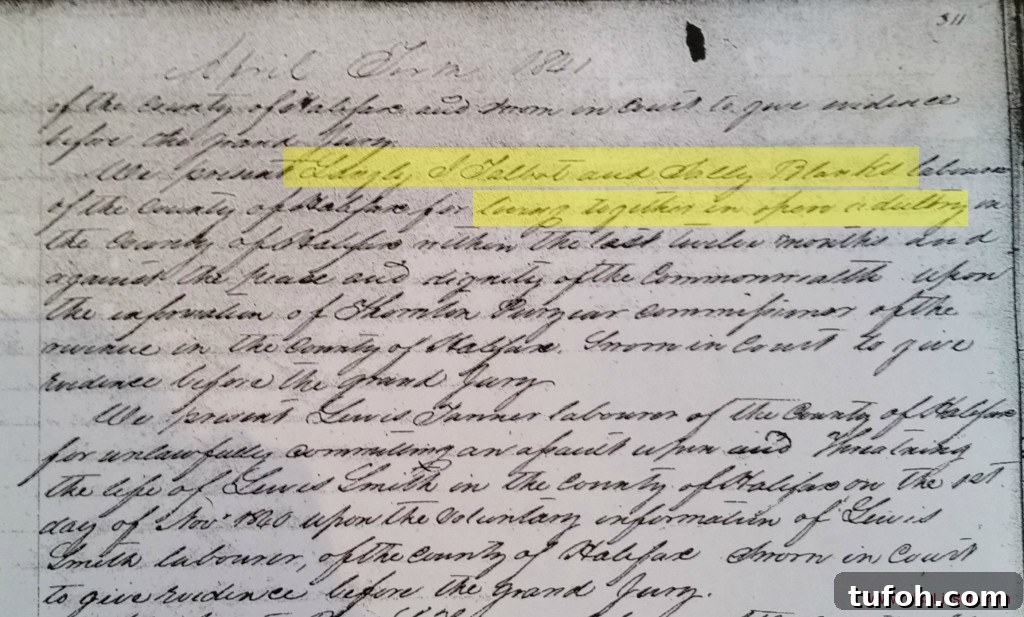
Digging further into county court records revealed more context: David’s will hinted that Langley had problems with gambling, and Halifax County court files contained an 1841 grand jury summons charging Langley and Sally Blanks with “living together in open adultery.” Taken together with the dates, the records indicated a long-standing relationship more like a common-law union than a formal marriage.
Further research showed that Sarah Blanks had previously been married to Thomas Blanks and was the mother of their son, Alfred Blanks. Her maiden name was Talley. After Thomas’s death, Sarah and Langley formed a long-term relationship, and their children used the Talbott surname although no formal marriage record existed.
How to Avoid Making Genealogy Mistakes in Your Research

To prevent false assumptions and avoid the same mistake I made, develop habits that force careful evaluation of records:
- Take your time in the records: Read each document fully—don’t just extract a date or name. Look for phrasing, marginal notes, relationships, and conditions that reveal context.
- Understand the social role of women: Learn how widowhood, remarriage, and community customs affected naming and legal status in the period and place you’re researching.
- Explore less-used records: Court files, grand jury records, tax lists, and estate documents often contain key details that standard sources do not.
- Trust your research instincts: If a record feels inconsistent, follow that intuition and search for corroborating or contradictory evidence.
I’m glad, in a way, that I made the mistake. It taught me how to be a better researcher and to question seemingly obvious conclusions. Re-examining assumptions, digging into court and probate records, and applying informed reasoning helped me solve the mystery of Sarah Blanks and Langley Talbott.
Other posts of interest:
- How To Use WorldCat For Your Genealogy Research
- Genealogy For Beginners – Start Finding Your Ancestors!
- How to Create Your Genealogy Research Plan
- How To Research Genealogy in 20 Minutes a Day
Note: If you’re a Talbott researcher, I have additional information and would be glad to hear from you.
Disclosure: This post originally included affiliate references. Recommendations reflect tools and services the author uses.